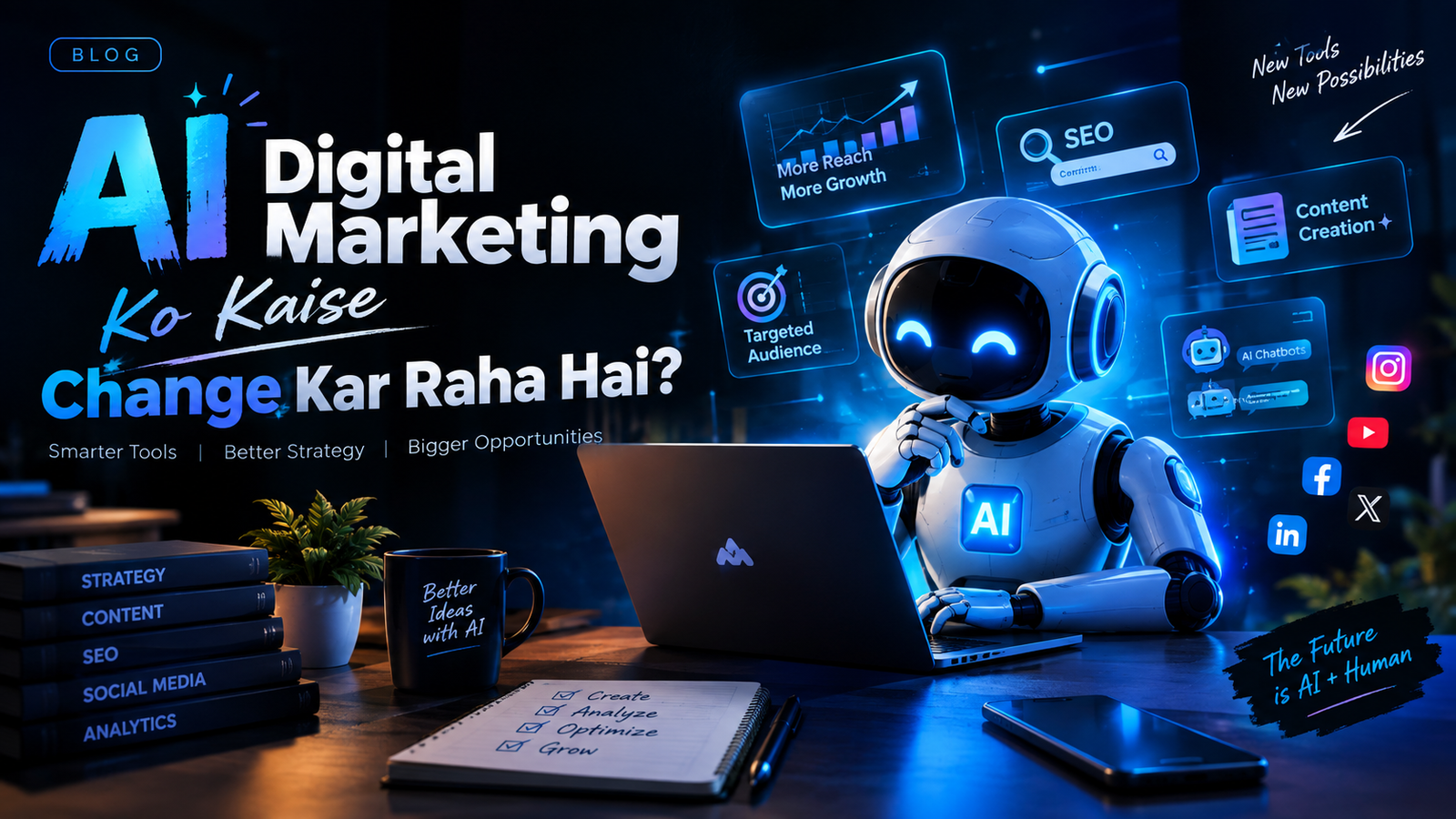
Digital marketing has changed a lot in the last few years. From social media and search engines to email marketing and content creation, businesses are using digital platforms to reach their customers. But now, there is another technology changing the way digital marketing works — Artificial Intelligence (AI).
AI is not just a trend anymore. It is becoming a useful tool for marketers who want to save time, understand their audience better, and create more effective marketing campaigns. But how exactly is AI changing digital marketing? Let’s understand it in simple terms.
1. Faster Content Creation
One of the biggest changes AI has brought to digital marketing is content creation.
Earlier, marketers had to spend hours researching topics, creating ideas, writing captions, and preparing blog content. Today, AI tools can help generate content ideas, headlines, social media captions, blog outlines, and even first drafts within minutes.
However, this does not mean marketers can completely depend on AI. Good content still needs a human touch. Marketers need to check facts, add personal experiences, understand the audience, and make the content interesting.
The best approach is to use AI as an assistant rather than allowing it to replace creativity.
2. Better Understanding of Customers
Understanding customers is one of the most important parts of digital marketing.
AI can analyze large amounts of data and identify patterns in customer behavior. For example, it can help businesses understand what people are searching for, which products they are interested in, what type of content they interact with, and when they are most active online.
This information can help marketers create campaigns that are more relevant to their target audience.
Instead of creating the same message for everyone, businesses can use customer data to create more personalized experiences.
3. AI Is Changing SEO
Search Engine Optimization, or SEO, is another area being influenced by AI.
Search engines are becoming better at understanding what users actually want when they search for something. Because of this, simply adding keywords to an article is no longer enough.
Marketers now need to focus on useful, relevant, and easy-to-understand content that genuinely answers people’s questions.
AI can help marketers with keyword research, content ideas, competitor research, content optimization, and identifying topics that people are interested in.
But SEO still requires strategy. AI can provide suggestions, while the marketer has to decide what makes sense for the website and its audience.
4. Personalized Marketing
Have you ever noticed that after searching for a product online, you start seeing advertisements related to that product?
This is an example of how data and AI-powered systems can be used to personalize digital experiences.
AI can help businesses understand individual customer interests and deliver more relevant recommendations, emails, advertisements, and content.
For example, an online store can recommend products based on a customer’s previous searches or purchases.
Personalization can make marketing feel more relevant because customers are more likely to notice content that matches their interests.
5. Social Media Marketing Is Becoming Smarter
Social media marketers also benefit from AI.
AI tools can help generate post ideas, write captions, analyze engagement, identify trends, and assist with content planning. Some tools can also help marketers understand which types of posts are performing better.
This allows marketers to spend less time on repetitive tasks and more time thinking about creative campaigns and audience engagement.
Still, social media is about people. Understanding emotions, trends, culture, and conversations requires human judgment. AI can support the process, but authentic communication still matters.
6. AI Chatbots and Customer Support
Another major change is the use of AI-powered chatbots.
Businesses can use chatbots to answer common customer questions, provide basic information, guide visitors, and offer support at any time of the day.
For example, a customer visiting an online store may ask about delivery, return policies, or product details. A chatbot can provide an immediate response without requiring a human employee to answer every basic question.
This can save time for businesses and provide quicker responses to customers.
7. Marketers Need New Skills
As AI becomes more common, the role of a digital marketer is also changing.
Marketers don’t necessarily need to become AI experts or programmers. But learning how to use AI tools effectively can become a valuable skill.
Modern digital marketers may need to understand areas such as AI-assisted content creation, data analysis, automation, SEO, social media tools, and prompt writing.
At the same time, traditional skills like creativity, communication, strategy, research, and understanding customers remain important.
The Future of AI and Digital Marketing
AI is changing digital marketing, but it is not simply about replacing marketers. In many cases, it is helping marketers work faster and handle tasks that previously required a lot of manual effort.
The future will likely belong to marketers who know how to combine AI with human creativity and strategy.
AI can generate ideas, analyze data, automate repetitive tasks, and provide useful insights. But humans still need to decide what message to communicate, who to communicate with, and why it matters.
Final Thoughts
AI has already started changing the digital marketing industry, and its role will continue to grow. From content creation and SEO to personalization, social media, and customer support, AI is becoming part of everyday marketing work.
For beginners who are learning digital marketing, this is actually an exciting time. Instead of being afraid of AI, marketers can learn how to use it as a tool to improve their skills and productivity.
The important thing is simple: Don’t let AI replace your thinking. Use AI to make your thinking more powerful.